|
by
Patricia A. Kaufmann
Due
to the revolutionary nature of the material presented, this
article appeared in both The American Philatelist and
The Confederate Philatelist at the same time in February
2000 by joint cooperation of the editorial teams. The research
resulted in the addition of a completely new section in the
Scott Catalogues. If you don't have Broadband Internet
connection, this may take a while to download as it is graphic
intensive, but ultimately worth the wait.
Sixteen
years ago, I wrote a feature article, published in The American
Philatelist, 1 suggesting
that there was a third and different type of postmaster provisional,
partly U.S. and partly Confederate, which had never been addressed
by the appropriate philatelic catalogues such as Scott 2
or Dietz 3. These are the
3-cent provisionals issued by postmasters in states declaring
allegiance to the Confederacy before the Confederate postal rates
went into effect on June 1, 1861.
The
Confederate States of America was formed on February 4, 1861.
On February 9, 1861, the Confederate Provisional Congress at Montgomery,
Alabama, adopted an act to continue in force laws of the United
States of America until the Confederate Congress could change
such laws. By default, this established the postal rates of the
Confederate States as being the same as those of the United States.
4. The act
prescribing the rates of postage in the Confederate States of
America was passed and received presidential approval and signature
on February 23, 1861, but did not go into effect until June 1,
1861.
Postmasters
from the seceded states that joined the Confederacy found themselves
in a very difficult position. While most postmasters were sympathetic
to the South and intended subsequently to accept Confederate postmaster
commissions, they were still
technically under oath to the United States Post Office Department
until June 1, 1861. The United States demanded a confirming oath
from these Southern postmasters before shipping additional supplies
of U.S. stamps to them during the period between the formation
of the Confederacy and June 1, 1861.
5 Confederate Postmaster General John H. Reagan
advised Southern postmasters that, in the interests of the people
in both parts of the country, it was the wish of the Confederate
government that all postmasters continue their duties, render
their accounts, and pay all monies to the government of the United
States until the Confederate Post Office Department could assume
control over its own postal affairs. 6
In a letter written by Reagan in 1898 in reply to some inquiries
concerning Confederate postal matters, he explained the Confederate
Post Office Department's official position relative to postmasters
provisional stamps. 7
I stated
in the report referred to that it was necessary "to leave
it to postmasters and person paying postage to arrange between
themselves the manner in which these notes may be used."
Under this condition occurred the issuance of local stamps and
stamped envelopes by quite a number of Confederate
postmasters.
The preceding
information is merely a condensation of the vast basis for my
proposal that there should be a third category of provisionals.
In the original article, I gave the history of the 3-cent issues
from Madison, Florida; Jackson, Mississippi; Hillsboro, North
Carolina; Tuscumbia, Alabama; and Nashville, Tennessee. On the
whole, this article was extraordinarily well accepted by the philatelic
community. I subsequently received many letters and accolades
as well as information on other contenders for this new classification.
All of sudden, I become the clearing house for anything of an
ambiguous nature and more listings have since been added to this
post-secession provisional category.
Michael Laurence,
editor of Linn's Stamp News, wrote three different editorials
quoting my research, adding his own thoughts an swelling my head
with praises such as "Kaufmann's article is one of the most
impressive pieces of philatelic research we've ever encountered."
8-10
Shock
and Deflation
Imagine
my shock and devastation when, after confidently having sent off
several of the Madison, Florida 3-cent provisionals written up
in the article, they came back from the Philatelic Foundation
in March of 1895 with "decline opinion" instead of good
certificates. How could this be?
J.
W. Scott, the found of the Scott Catalogue himself, had
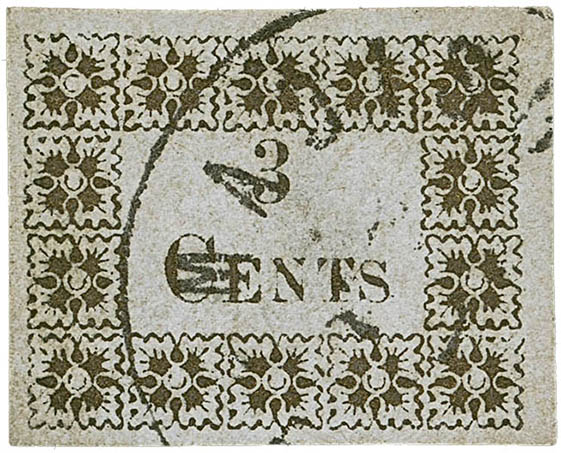
discovered the first of the Madison provisionals (the "CNETS"
error) and stated in 1872 that "the Madison was the first
issued, best authenticated, and scarcest Confederate provisional".
11 It was
listed in the Scott Catalogue at that time at least through
1896 and probably for decades thereafter.
12 Another of the rare provisionals (the only known Confederate
rated 5-cent press printed entire) was discovered in 1895 by C.
H. Mekeel, founder of Mekeel's Weekly Stamp News. 13,
14 The Madison provisionals had passed through the greatest
of collections of the late nineteenth
and early twentieth centuries including Caspary, Ferrari, Hind,
Duveen, Moody, Lapham, Judge Philbrick and Sir William Avery.
I had spent days at the National Archives on my original research,
pored over vast numbers of philatelic volumes and corresponded
with endless experts - all seemingly for naught.
A chat over
lunch with one of the Philatelic Foundation staff revealed that
no one knew exactly why the Madisons had been de-listed from the
various catalogues years before. A reply from Scott Publishing
revealed that "Any files of J. W. Scott before 1880 were
burned in a fire. Also, any files dated up to 1950 are not available
as they are the property of private owners." 15
No answers were forthcoming from the Scott archives. Another concern
expressed by the Foundation was
that they did not have records of any other examples of the canceling
devices used on the Madisons, either the oblong "PAID"
or the rare small Madison "FLO" circular datestamp.
Furthermore, the name of Dr. James A. Petrie was associated with
the Madisons. Petrie was known to have openly boasted of having
sold Ferrari many of the fakes and counterfeits in his remarkable
collection.16
All
of these were genuine concerns, but I was still quite secure with
my prior research and conclusions. The only suggestion, which
seemed totally irrational to me, was that the original papers
I had found in the National Archives written by Madison p ostmaster
Samuel J. Perry might somehow have been "planted" by
Petrie to help authenticate the provisionals. These letters were
published in my original article. This suspicion seemed unlikely
to be true, as the reply from Perry to the U.S. Post Office Department
would not have been specifically referenced in the Baltimore
American and Commercial Advertiser on March 21, 1861 had it
been a "plant".
The
Foundation did not condemn the Madisons. They merely required
more proof. As with any Authentication Committee, it is up to
the submitter to do the research and present it to the committee.
It is not the job of the committee to do the research, or certificates
would cost thousands of dollars each and "patients"
would take years to process. I momentarily was dejected, but now,
with my work cut out for me, I put myself in the mindset for positive
action.
The
Quest Begins Anew: Cancel Corroboration
First things
first. I needed to corroborate the cancellations that were used
on the known Madison provisionals. In November 1984, I wrote to
those who might be able to provide supporting evidence, from Florida
collectors and dealers to handstamped paid experts. I was deluged
with a truckload of helpful information and acquired many corroborating
Madison covers along the way. Among other things, it was erroneously
suggested by some that cancellations with other than "FLA"
weren't used in Florida during the Civil War. It didn't take me
long to come up with small "FLO" postmarks from Pensacola,
Saint Augustine, and, thankfully, Madison. The late eminent handstamped
paid student, Morris Everett, sent me a survey of all the Madison
handstamped paids of which he was aware, their sources, and when
they had been sold. 18 Among
them were two Type II Madison oblong PAID's from the Borland correspondence.
They appear to have been the covers from which the Type II was
listed. 19 Publisher/dealer
David Phillips checked his files on both the American Stampless
Cover Catalog and Confederate
Stampless Cover Catalog and
supplied me with photocopies of Madison postmarks before, during
and after the Civil War.20
On
November 29, 1984, the late Bill Bogg, a prominent Confederate
dealer, Florida collector, and good friend, pointed me to the
clinching cover, which he said came from the Henry Spelman collection.
It was a 3-cent Star-Die envelope canceled with the "Feb
20 (1861) Madison, FLO" marking that became incontrovertible
proof that the "FLO" cancellation was used during the
provisional period. The U.S. 3-cent Star-die envelopes were not
issued until after February 1860 and were not valid in the Confederacy
in 1862, thus narrowing down the usage to 1861. This is a well-accepted
proof of dating among Confederate postal history students.
The
Star-Die cover, as well as the others that I had accumulated in
my all-out efforts, clearly produced a ti me
line theory, illustrated herein with the actual markings on cover.
The small Madison "FLO" postmark appears to have been
used during 1861 through early 1862, as does the oblong PAID.
The large Madison, FLO was used in early 1862. It appears that
these two canceling devices were discarded, probably because of
wear
or breakage, and there followed an interim period where only manuscript
cancellations are found during 1862 and 1863. Finally, the larger
and most common "FLA" cancellation is found during 1863
and 1864.
From
Confederate Newspapers to Postmaster Descendants
April
8, 1985, was a red-letter day in my Madison research. It began
at the Library of Congress and ended in a long phone conversation
with the great-great grandson of Confederate Postmaster Samuel
J. Perry.
The
first phone call I made that day was to the newspaper section
in the Library of Congress. They did not have a copy of the Madison
Recorder, the newspaper of the day in Madison, Florida where
I thought the stamps were printed. I noted with amusement that
the reading room of the Library of Congress is LM-133 in the Madison
Building - a nice coincidence. That seemed a good omen. One of
the staff there told me that a copy of this rare paper was on
file at Florida State University in Tallahassee and University
of Florida in Gainesville, I also called Florida telephone information
in hopes of finding descendants, but there was no one by the name
of Perry listed in Madison in 1985.
According
to the records in the Florida State Library in Tallahassee, The
Madison Recorder was published from 1865 until June 1908.
I later was renamed The New Enterprise and subsequently
The Enterprise-Recorder, under which name it is published
today. In a phone call to the office of the paper, I asked if
there was any type of historical society in Madison and was put
in touch with Beth Sims who was writing a book on Madison County
history. I asked her if she had ever heard of a postage stamps
from Madison and she said that she had. Furthermore, she indicated
that a friend had sent her a copy of The American Philatelist
that had a story in it about the Madison provisionals. I told
her that I was the author of that article. Mr. Sims then went
on to tell me that William Perry, who was Postmaster Samuel J.
Perry's son, had printed the Civil War era newspaper in Madison,
but that she did not think there were any copies extant. She also
noted that a descendant of Perry's was being buried as we spoke.
Mrs.
Sims gave me one of the most important leads in my new quest -
the name of James H. Perry of Palatka, Florida. She indicated
that he and his wife were doing genealogical research on Samuel
Perry. I was getting closer. I made several phone calls, but to
no avail.
In
the meantime, I continued with my library research. Mrs. Sims
called me back in the afternoon to say that the paper that I really
wanted was The Southern Messenger. I already had uncovered this
same information at the P. K. Younge Library, which had an issue
from December 25, 1858, as well as two issues from April 20 and
April 27, 1866. I ordered photocopies of the entire paper via
the Inter-Library Loan Program to find the fancy type from which
the border of the provisional stamps was made. I found that the
typeface of the "3-cents" matched that of the paper,
but I never did find the border.
That
evening, I finally got through by telephone to James H. Perry,
who is known as "Buddy". He was excited to hear from
me and surprised to find out that his great-great-grandfather,
Samuel James Bradley Perry, had been postmaster during the Civil
War. He said that he knew very little about this particular period
of his family, but hat he had been doing a great deal of genealogical
research. He always referred to Samuel J. Perry as "Colonel
Sam" because he was a judge and that is how they referred
the judges in those days. It turns out that Colonel Sam's son,
William was not only the editor of The Southern Messenger in
Madison, but also of newspapers in Americus, Georgia, about 1870
and in Jacksonville, Florida in the early 1870's. Buddy indicated
that he had Colonel Sam's signature on land deeds, probate items,
and his last will and testament, as well as on other documents.
This was to play a crucial part in another phase of my research,
the verification of Colonel Sam's handwriting by a professional
graphologist.
Buddy
Perry and his wife, Mary Jo, invited my late husband, John, and
me to dinner at their home in Palatka during our research trip
to Florida a few weeks later. We had a wonderful time and the
mutual exchange of information was very productive for all of
us. Mary Jo was the conference chairman for the Florida State
Genealogical Society, and thus had a wealth of knowledge on Florida
pioneers. The Perrys most generously provided me with copies of
many original family documents such as voting records, Colonel
Sam's obituary, the 1870 census in which his family appeared,
letters written by him asking for the right to survey roads in
Madison, field notes made during his surveys, his Indian War pension
papers, and copies of church records when he was a clerk of the
session.
Samuel
James Bradley Perry
Samuel
J. Perry was born near Sumter, South Carolina on August 25, 1810,
21-23 the
middle of three children of Senator John Perry of South Carolina.
24 He married
Margaret P. McIlveen on December 25, 1828, in Kingstree, South
Carolina, and his first two children were born in South Carolina.
He moved to Madison County, Territory of Florida, in 1832 or 1833,
following his sisters, Mrs. Pillans. His next three children were
born in Madison. Perry died on December 11, 1898, while working
on his stock farm near Madison, having outlived four of his five
children. He is buried in Oakland Cemetery near Madison.
Perry
enlisted at San Pedro, Florida as a private in the company of
mounted volunteers commanded by Captain Thomas Livingston during
the Seminole Indian War. He later served twelve months under a
commander named Bradley and was discharged in 1837. His civic
commitments over the years were many. He served as judge of the
county court of Madison from 1834 to 1839. He was appointed and
served as county tax collector from 1839 to 1845. He was the precinct
election clerk for Madison County in Florida's first election
after statehood and his name appears on the voters roll in Madison
County in 1845. Perry was deputy surveyor for the state survey
conducted in 1853 and 1854 with U.S. Surveyor General John Westcott.
They surveyed thousands of acres of land in South Florida as far
as the shores of Lake Okeechobee, long before the Indians were
transported or driven back into the Everglades or that part of
the state was settled by the white man. 25
Colonel Sam was one of the three original founders of the Presbyterian
church in Madison in 1840. At the age of 75, he still was going
strong and was elected superintendent of education in 1885. His
five children also enriched the community of Madison. Of particular
note to postal historians is his eldest son, William, who printed
the Madison provisionals as the editor and publisher of The
Southern Messenger. Another son, Captain Thomas A. Perry,
was a doctor who fought in the Civil War and was killed during
the Battle of Seven Pines. May 31-June 1, 1861 (called the Battle
of Fair Oaks by the North, both sides claimed victory in the engagement,
but the losses were brutally high: 6,180 Confederate casualties;
5,031 Northern casualties.)
Colonel
Sam's obituary in the Jacksonville Florida Times Union
26 stated that "He
was one of the few remaining landmarks of the old pioneer settlements.
He was a man of fine intellectual attainments, a Christian gentleman
and a patriot, honored by all who knew him. His remains were interred
at Oakland Cemetery beside that of the wife of his youth, who
had long ago preceded him." His first wife died in 1872.
His second wife was Susan Rutherford.
Madison
Stamps Cause a Scandal in 1861
In
my original article, I quoted The New York Herald, which
early in 1861 had announced: "The PostMaster at Madison
Fla has offered P Office Stamps contrary to Law." In
the National Archives, I found the original letter that Postmaster
Perry wrote to U.S. Postmaster General Montgomery Blair on March
8, 1861, refuting these charges. I published that letter in my
article as well. A search of the Blair letter book revealed that
he was answered in March 1861, but the letter was not in the records.
As a result of the original Herald article, a postal inspector
was sent from Washington to interview Perry, who apparently explained
himself to the inspector's satisfaction. A March 1861 issue of
the Fayetteville, North Carolina Observer indicated, however,
that he was severely lectured the third assistant postmaster general.
An article in the march 1872 American Journal of Philately
published a long detailed letter from former Postmaster Perry
to J.W. Scott in response to Scott's inquiry after discovering
the "CNETS" error, a small portion of which is quoted
here.
The
keen perceptions of James Gordon Bennett of the New
York Herald
found an immense and ingenious fraud practiced upon the Government
by the postmaster at Madison, and called hastily for justice
to visited upon the moral deformity of the offending postmaster
at Madison. His exquisite sense of purity could not conceive
how a sense of duty on the part of the officers of the distributing
office could allow the offense of the postmaster at Madison
to go unnoticed. He devoted nearly a column of the Herald
to the subject, and I found myself suddenly famous through the
Herald's
cleverness in discovering villainy. Shortly after the Herald's
attention, an agent of the Government was sent especially to
investigate the fraud; but he was a sensible gentleman, and
was immediately convinced that no wrong was intended and so
reported to his Govenment...I was continued, without further
complaint...when I made the proper returns and paid up all dues
in money.
A
Visit Back in Time
The
morning after we had dinner with Buddy and Mary Jo Perry at their
home in Palatka, we were finally on our way to Madison, Florida.
Our first stop was Oakland Cemetery. At 8:30 a.m., we drove our
rental car down the winding red clay and sliding sand road past
peaceful farm fields dappled with spring wildflowers. We followed
the tractors treads on the dirt road through a tunnel of live
oak trees draped in Spanish moss to an unkempt cemetery hidden
behind rusty iron and brick gates. Five small Palmetto trees flanked
the gates and the cemetery was dotted with more Spanish moss covered
trees.
We
found the Perry family markers broken in half and darkened with
mildew. They were set back away from most of the other gravestones.
We took pictures as they were found and then set the top halves
on the bottoms to properly reconstruct the ponderous teetering
slabs. I gathered a handful of wildflowers to place on he grave
and said a small prayer for Colonel Sam and his family. I noted
that his headstone inscription erroneously recorded the year of
his death as 1899.
Our
trip into Madison was just as fascinating as we had anticipated.
We visited the gold-domed court house, the post office, the local
library, and the office of the current local newspaper, The
Madison Enterprise-Recorder. We met with Mrs. Elizabeth Sims
of the Madison Historical Society, who subsequently published
her book on the history of Madison county, 27
to which she added the stony of Colonel Sam's stamps. I discovered
even more reference material - far too voluminous to cover here.
One of the more interesting titles that I encountered was Scenes
in a Surveyor's Life or a Record of Hardships and Dangers Encountered
and Amusing Scenes which Occurred in the Operations of a Party
of Surveyors in South Florida by W. L. Perry. 28. This lengthy
mouthful of a title was a collection of anecdotes from Colonel
Sam's illustrious past as written by his son.
We
pored over old newspapers at the offices of The Madison Enterprise-Recorder
for hours. I chuckled at the tag line on the paper's masthead
"Since 1865 'telling it like it is...and defending the
peasants' right to know!'" I subsequently even ran an
ad in that publication looking for information on the Madison
provisionals - or, better yet, for someone who might still have
a 1-cent, 3-cent, or 5-cent stamps he was willing to sell! That
philatelic fantasy, of course, remained just that - a fantasy.
One
news article from 1919 did catch my eye. It was titled "That
Confederate Post Stamp". 29
An old
timer of Washington once a resident of this town writes entertainingly
of this stamp, he has a retentive memory and his mind is chock
full of interesting facts. Tradition claims that during the
War of the 60s when Col. S.J. Perry was Postmaster in Madison,
the times were strenuous and there were no Post Stamps to be
procured, so Col. Perry designed and manufactured this one and
put it into circulation. The picture of this stamps is to be
seen in many large Philatelic catalogues. There is neither art
or skill in its make up, but no doubt on a genuine Confederate
envelope it would be a valuable prize to a Philatelist. The
late Col. Perry was a most magnetic conversationalist and in
talking of the days when he invented a Post Stamp he was eloquent.
Handwriting
Analyses
With the acquisition
of so many documents with Colonel Sam's handwriting and signatures,
my next step was to find a graphologist to compare a half dozen
samples of his handwriting. I chose a leading handwriting expert,
the internationally respected Marie Barnard, who has written over
a dozen books of graphology as well as co-authoring Anatomy
of Evil with Charles Hamilton, the esteemed autograph dealers,
for whom she wrote over 160 analyses of Nazi leaders. She has
taught graphology in New York's City College, the University of
Bridgeport, and the John Jay College of Criminology, as well as
appearing regularly in court as a questioned document examiner.
I sent Ms. Bernard copies of six items: the provisional stamp
with the manuscript cancel; the letter on file at the National
Archives to the U.S. Postmaster General dated March 8,
1861; the letter from Perry to Dr. Petrie in 1880; and a few covers
with manuscript cancels and addresses in Perry's hand that came
from an original find made by Joe Holleman. 30
In a multi-page analysis, she returned the opinion that there
was no doubt that they were all written by Perry.
A
Special Meeting of the Philatelic Foundation
Finally, I
felt that I had an overwhelming amount of evidence that the experts
at the Foundation could not ignore. In May 1987, I sent the a
one-inch thick report with 18 pages of footnoted text with 33
separate exhibits such as the handwriting analyses, many of which
were several pages long. After almost a year, during which time
various experts had the opportunity to examine the research, a
special meeting was called in March 1988, which John and I were
invited to attend in person.
It was an
active evening of open dialogue that ultimately ended with with
the Madison stamps and covers determined "genuine".
The Confederate 5-cent press-printed cover received an opinion
that "it is a genuine pre-printed Confederate Postmaster
Provisional entire used from Madison C. H., Florida." 31
The other opinions, although declaring the patients "genuine",
contained most unusual wording. 32
One of the used adhesives was described at an "1861 3-cent
bronze used with Madison Florida cancellation" with the opinion
that "it is a genuine printed adhesive used as indicia of
prepayment of postage at Madison Florida but not authorized by
the U.S. Post Office." I was stunned. I felt like I'd won
the battle but lost the war.
Michael Laurence
once again took up the subject in his editor's column 33
in Linn's Stamp News.:
The Foundation
very carefully worded its certifications so as to avoid calling
the stamps postmaster provisionals. In four identically worded
opinions, the Foundation coyly described the Madison stamp as
follows "It is a genuine printed adhesive used as indicia
of prepayment of postage at Madison Florida but not authorized
by the U.S. Post Office."
In my
dictionary, this is precisely the definition of a provisional
stamp. Postmaster provisonals are stamps not authorized by a
national government, but issued by the local postmaster on an
emergency basis for the convenience of the public.
I spoke
to Peter Robertson, curator at the Foundation, to get an explanation
of the very peculiar wording. Since no provisionals have ever
been authorized by the U.S. Post office, I asked Robertson if
the Foundation intended to use similar wording on future certificates
for other provisional stamps, such as those from New York, Providence,
or St. Louis.
The answer
is no, not at all. Robertson agreed that other U.S. Postmaster
provisional stamps (Scott 1X1-11X8) were issued without authorization
by the post office.
The distinction,
he said, is that on the pre-1847 provisionals, there was no
direction specifically forbidding them. Around 1852, according
to Robertson, the post office issued regulations expressly prohibiting
postmaster provisional stamps. The Madison stamps, which were
created during a Civil War emergency in 1861, thus fall into
a different category.
This
strikes me as the sort of scholarship that in earlier ages would
have been devoted to determine how many angles could dance on
the head of a pin. In my view, a provisional is a provisional...
It is too bad that the Foundation refused to drop the other
shoe, to declare that these are genuine U.S. Postmaster provisional
stamps.
Square
Two
Well, I wasn't
exactly back to "square one", but neither had I crossed
home plate. I was dumbfounded that the Madisons had been declared
a sort of nebulous "indicia" and not even a postage
stamp, let alone a postmaster provisional or even an illegally
issued postmaster provisional. I still was determined to forge
ahead to procure the Madisons their rightful place in postal history.
I had approached
the Confederate Stamp Alliance Authentication Committee to take
up the gauntlet, but they were reluctant because I had originally
written them up as "U.S.", which is not something on
which the CSA passes judgment, as it is out of the realm of Confederates.
As I sat back
to take a breather from this situation and plot my next course
of action, my personal world fell apart with the sudden death
of my husband and business partner, John W. Kaufmann, from a cerebral
aneurysm. It is an understand to say that I was devastated. As
I spent the next decade picking up the pieces of my life, I still
had the Madisons tucked away in the back of my mind.
In
1996, I was asked to join the CSA Authentication Committee as
Recording Secretary, and subsequently, as a voting member. I had
the opportunity to discuss my theories about the Madisons with
the chairman of the committee at that time, Peter Powell. Peter
wrote a letter to all of the other members of the committee and
laid out the reasons why the CSA should consider accepting the
Madisons as patients. I t was agreed to accept them for consideration.
I submitted the same brief that I had submitted to the Philatelic
Foundation along with the patients. Due to the conflict of interest,
I was not part of the voting process. This time the Madisons finally
got their just due as "3-cent Madison, Florida post secession
postmaster provisionals." 34
What's
in a Name?
My original
article called the Madisons "U.S. 3-cent 1861 Postmaster
Provisionals Used in the Confederacy," a title I rationalized
because the money was actually paid to the United States Post
Office Department for the service rendered. On the other hand,
since as the Foundation pointed out, they weren't authorized by
the USPOD, the Confederate Post Office Department had unintentionally
authorized them by telling the postmasters to do whatever was
necessary. The choice of an appropriate name is endless, from
the one I originally gave them to the CSA Authentication Committee's
"post secession postmaster provisionals" or "Confederate
Provisionals Prepared for the Union Rate." There are many
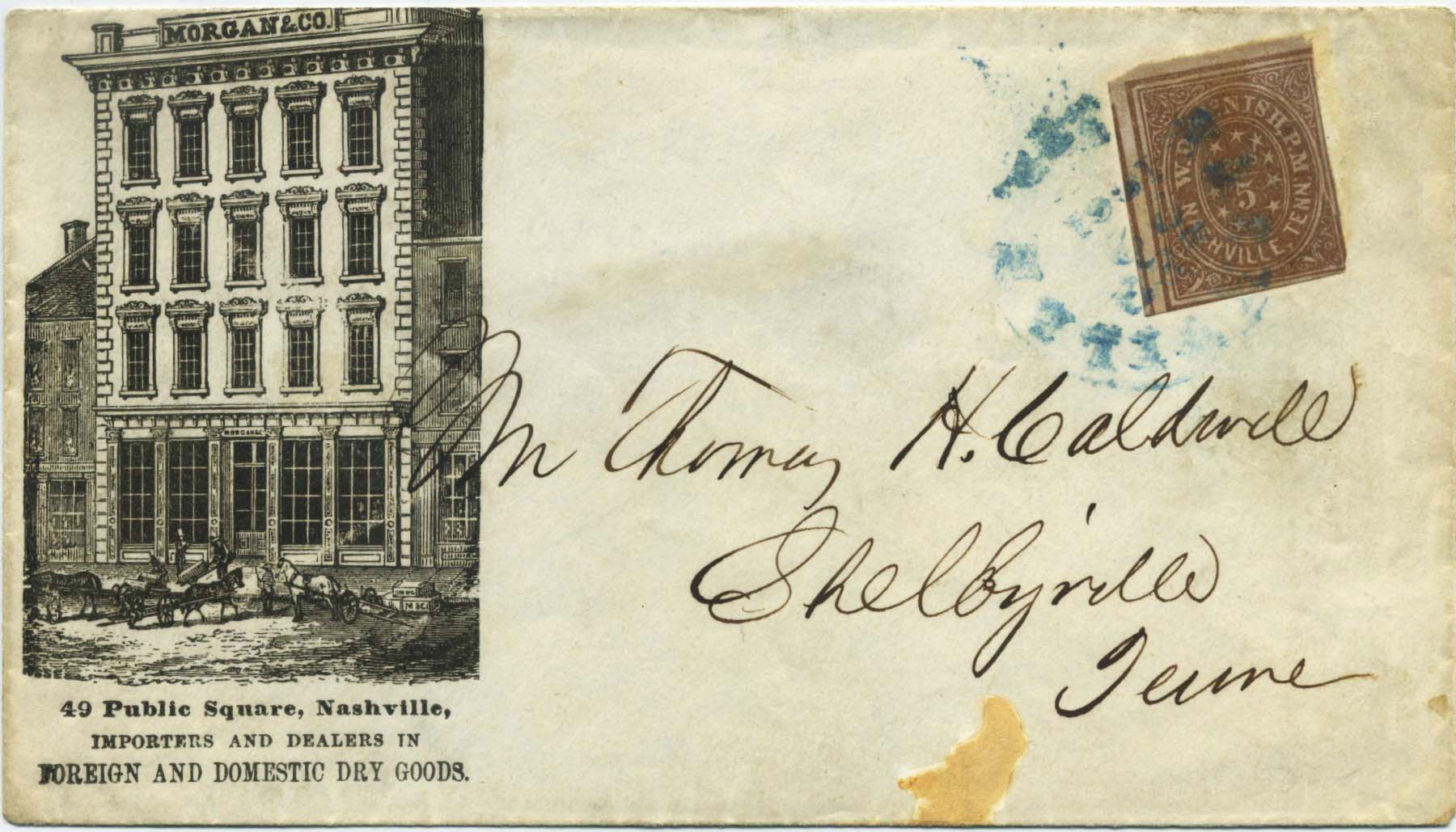
possible monikers, although the 3-cent Nashville provisional does
not easily fall into the aforementioned categories for reasons
not relevant to this article. I suspect that whatever the Scott
Catalogue ultimately calls them will determine how they will be
known in the future. My final personal suggestion would simply
be "3-cent 1861 Postmasters' Provisionals." (2005
Editorial Note: that is just what they were ultimately called.
A completely new section of the Scott Catalogue was created, immediately
preceding the Confederate section. It included all of the provisionals
cited in the original article, including moving the Tuscumbia,
Alabama provisional from the U.S. section to the new 3-cent section.)
Survey
of Recorded Examples
There
are 5 off-cover used examples of the 3-cent Madison provisional,
virtually all quite different, as well as a single known 3-cent
used on cover. There is only one known Confederate 5-cent typeset
press-printed provisional entire of the same design. Colonel Sam
wrote to U.S. Postmaster General Montgomery Blair on March 8,
1861 that he also had prepared a 1-cent stamp, although a copy
has never surfaced. In speaking of his stamps, Colonel Sam wrote
that "Ordinary foolscap paper was used." The wove paper
is pale blue and, during the printing process, gold or bronze
dust was blown on the ink before it was dry. This created some
of the most attractive provisionals extant. The actual stamp design
is 21 mm wide by 17 mm high. Fourteen boxed ornamental stars comprise
the frame surrounding the value. The center of each star contains
a semicircle. Close examination reveals that the semicircles do
not all face in the same direction. This makes these stamps easy
to type.
- 3-cent
Madison, Florida postmaster
provisional
canceled with the town cancel - 2
copies known. One is illustrated in this article. A photocopy
of the other is in the Philatelic Foundation files, as well
as Kaufmann files. It may be the copy that was at one time owned
by the Weill brothers in New Orleans. Raymond Weill does not
know the current owner or to whom it was sold.
- 3-cent
Madison, Florida postmaster
provisional canceled with a manuscript cancel (P)aid in (Money)
- one known.
- 3-cent
Madison, Florida postmaster
provisional with
slash pen cancel 35
- one known. Stolen from Stanley
Piller's dealer stock at SARAPEX '00 in Sarasota, Florida along
with a section of the John Hill collection of Confederates.
(2005 Editorial Note: subsequently
recovered and the Madison stamp was what enabled the stolen
goods to be identified easily.)
- 3-cent
Madison, Florida postmaster
provisional "CNETS"
error, town canceled, one known.
- 3-cent
Madison, Florida postmaster
provisional canceled by oblong PAID cancel on cover with
a clipping from the original letter headed "Madison Florida
Feb 13 1861" and manuscript note "This part of letter
with envelope." Only 3-cent usage
known used on cover.
- 5-cent
black on yellow Madison, Florida postmaster
provisional press printed entire
used with Madison, Flo. Sep 2 (1861) town cancel - one
known. 36
In
Conclusion
There are
many appropriate adages for this time-consuming project, such
as "Quitters never win and winners never quit." Tenacity
played a large part in the successful outcome of this undertaking.
Most serious postal historians have a little pile of problematic
covers for which they don't have all the answers. Simplistically
speaking, postal history is research work in progress. New discoveries
and fascinating theories crop up all the time, no matter how old
the subject. They are the fodder for publications such as this.
It is part of the inherent satisfaction of postal history. We're
all philatelic detectives at heart. The roller coaster ride of
the "chase" is alternately frustrating and exhilarating,
but ultimately oh so rewarding.
Somewhere,
Colonel Sam is chuckling about all the hoopla over those pretty
little golden stamps that he fashioned at the dawning of the War
for Southern Independence. A tip of the hat to you, Colonel Sam!
Acknowledgments
George
W. Beatty, Marie Bernard, William G. Bogg, Gordon G. Bleuler,
John Brown (Inter-Library Loan Office, University of Florida,
Gainesville), Frank L. Byrne, William T. Crowe, Morris Everett,
Richard B. Graham, Erin R. Gunter, Joseph T. Holleman, Edward
R. Joyce, John W. Kaufmann, Steve Kerber (P. K. Younge Library,
University of Florida), Charles E. Kilbourne, Billy Matz, Herbert
P. McNeal, Jerry S. Palazolo, James H. Perry, Sr., Mary Jo Beck
Perry, David G. Phillips, Stanley M. Piller, Elizabeth Pope, Peter
W. W. Powell, Roberto Rosende, Warren H. Sanders, Hubert C. Skinner,
Frank J. Stanley, Thomas E. Stanton, Herbert P Trenchard, Scott
Trepel.
Endnotes
- Patricia
A Kaufmann, "U.S. 3-cent 1861 Postmaster Provisionals Used
the in the Confederacy", The American Philatelist,
98, No. 11 (November 1984) 1117-24.
- Scott
Specialized Catalogue of United States Stamps (Scott Publishing
Company, New York, 1984)
- August
Dietz, Dietz Confederate States Catalog and Handbook
(The Dietz Press, Inc., Richmond, Virginia, 1959)
- Ibid.,
pp. 21-23.
- Kenneth
W. Munsden and Henry Putnam Beers, Guide to Federal Archives
Relating to the Civil War (The National Archives, General
Services Administration, Washington, D.C., 1962) 428-29.
- Peter A.
Brannon, The Organization of the Confederate Post Office
Department at Montgomery and a Story of the Thomas Welsh Provisional
Stamped Envelope (Peter A. Brannon, Montgomery, Alabama,
1960) 59-60.
- August
Dietz, The Postal Service of the Confederate States of America
(The Dietz Press, Inc., Richmond, Virginia, 1929), pp 39-40.
- Michael
Laurence, "Editor's Choice", Linn's Stamp News
(November 12, 1984): 3, 10.
- Ibid, April
8, 1985, page 3.
- Ibid, April
18, 1988, page 3.
- J.W. Scott,
"History of the Confederate Post Office", The American
Journal of Philately, 5 (March 1872): 29.
- Frank L.
Byrne, personal correspondence, October 4, 1984.
- C.H. Mekeel,
"Some Interesting Confederate Stamps", Mekeel's
Weekly Stamp News (April 25, 1895): 3.
- C.H. Mekeel,
"The Madison Florida Provisionals", Mekeel's Weekly
Stamp News 15, no. 40 (October 4, 1902).
- Letter
from Scott Publishing Company May 3, 1985, signed Carol Williams.
- August
Dietz, The Postal Service of the Confederate States of America,
op. cit., page 81.
- Unsigned,
"Florida Postage Stamps," Baltimore American and
Commercial Advertiser (March 21, 1861):1.
- Morris
Everett, personal correspondence, November 1984.
- Confederate
Stamp Album,
supplement No. 3, Handstamped Paid Markings (Confederate Stamp
Alliance, June 1957).
- David G.
Phillips, personal correspondence, November 26, 1984.
- Brian E.
and Nora S. Michaels (eds.), "Florida Pioneers: Samuel
J. Perry," The Florida Genealogist (The Florida
State Genealogical Society, Tallahassee, Florida, Summer 1984),
page 115.
- James Howard
Perry, Sr. and Mary Jo Beck Perry, personal interview, April
28, 1985.
- Mary Jo
B. Perry, "Long Lost School Superintendent Found,"
The Madison Enterprise-Recorder (Madison, Florida, July
15, 1983): 3B.
- N. Louise
Bailey, Biographical Directory of the South Carolina House
of Representatives, 1791-1815 (University of South Carolina
Press, Columbia, S.C.), Vol., IV.
- Unsigned,
"Madison, Judge Samuel J. Perry Dead," Jacksonville
Florida Times Union ((December 17, 1898)
- Ibid.
- Elizabeth
H. Sims, A History of Madison County,Florida (Madison
County Historical Society, 1986), pp. 20-21, 58, 64.
- William
L. Perry, Scenes
in a Surveyor's Life or a Record of Hardships and Dangers Encountered
and Amusing Scenes which Occurred in the Operations of a Party
of Surveyors in South Florida, (Drews Book and Job Printing
Office, Jacksonville, Florida, 1859).
- Unsigned,
"That Confederate Post Stamp", The
Madison Enterprise-Recorder (Madison, Florida,
June 6,1919)
- Joseph
T. Holleman, notarized letter, May 24, 1985.
- Philatelic
Foundation certificate no. 0189961, March 15, 1988.
- Philatelic
Foundation certificate no. 0189962, 0189963, 0189964; March
15, 1988.
- Linn's,
op. cit, April 18, 1988.
- Confederate
Stamp Alliance Authentication Service certificates no. 2903,
29044, 2906; December 30, 1996.
- Philatelic
Foundation certificate no. 223533.
- Confederate
Stamp Alliance Authentication Service certificate no. 3408,
June 25, 1999.
|