|
by
Patricia A. Kaufmann
This
article appeared in The Confederate Philatelist, Volume
50, Number 1, Whole Number 344, January-March 2005. Additional
photos have been added to the on-line version for those not
as well versed in Confederate postal history or just for the
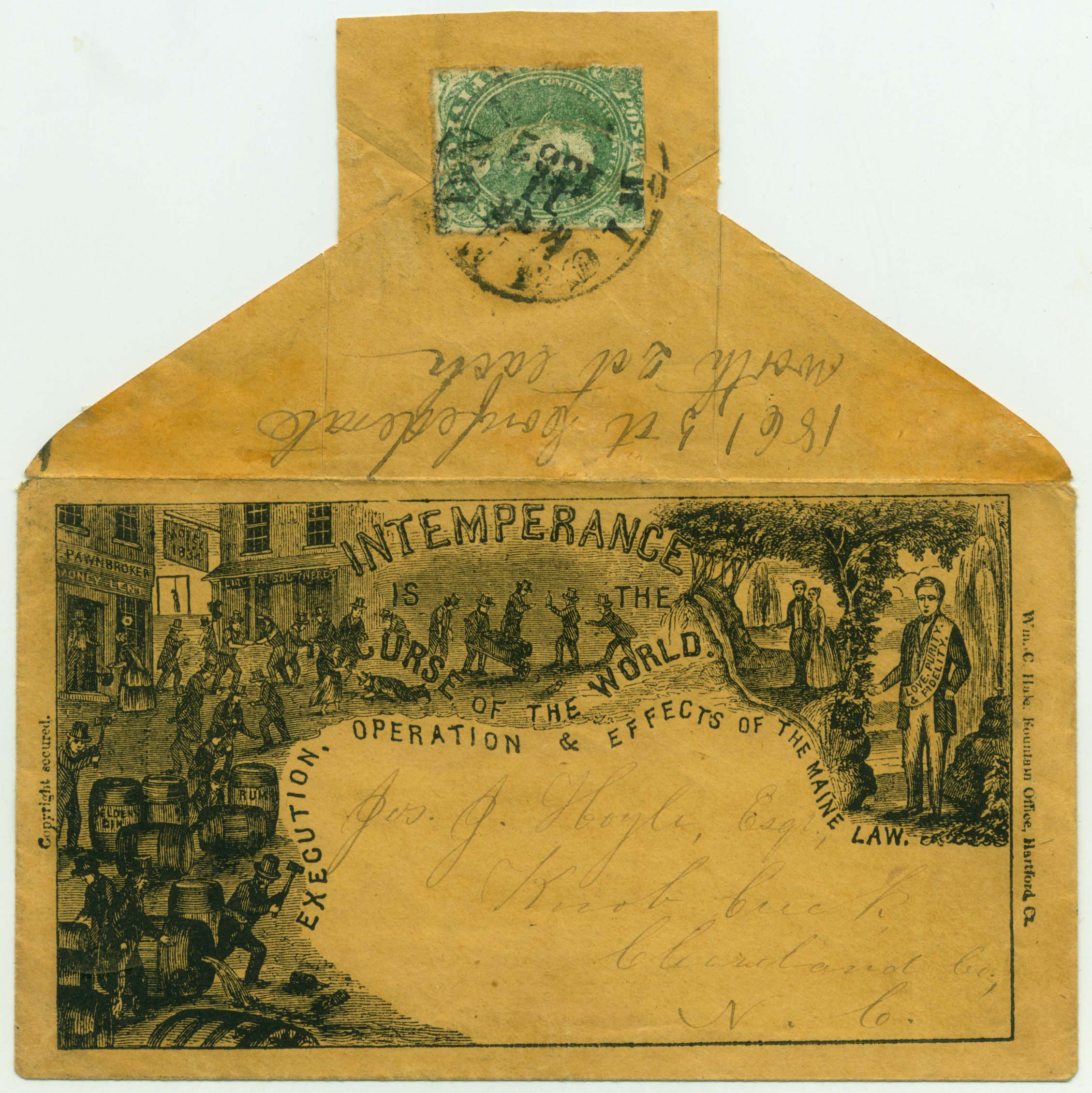
pleasure of those who are. Since this was published, the date has been getting consistently earlier. In 2008 the CSA Authentication Service gave certificates to July 13 and July 15, 1862 uses on cover and folded letter. While this makes this article "obsolete" in part, the Weaver history is fascinating and the articles spurred readers to look more carefully at their stocks and collections.
New
Earliest Known Usage
For years,
the date for the earliest known usage (EKU) of a Richmond (or
Local) Print (Scott #7) has stood at August 15, 1862 as promoted
by the father of Confederate philately, August Dietz. There is
really no other reason for this particular date to have stood
the test of time except that the Dietz name was attached to it.
For years, collectors and dealers have simply identified 5¢
typographed issues as De La Rue (Scott #6) printings if they preceded
the magic August 15, 1862 date. This date has stood for nearly
60 years since Stanley B. Ashbrook first reported it in 1946 in
the Emerald Book of The Stamp Specialist. 1
A number of
years ago, Scott Trepel of Robert A. Siegel Auction Galleries
came across an earlier pair from Richmond dated August 13, 1862
and included it on the "Civil War Timeline" information
on the Siegel Web site.2
For a number of reasons, this did not make it to the record books.3
It was from the John Hill collection and it is still out
there somewhere, now the second earliest usage known.
In September
2004, a pair of Richmond prints with a clear RICHMOND/Va./JUL/25/1862
circular date stamp affixed to a folded letter headed "Richmond
July 24th 62" was given a certificate as genuine by the Confederate
Stamp Alliance Authentication Committee. This article tells the
story behind that new presently earliest known usage.
The
Typographed Issues
The story
of the London prints (printed by Thomas De La Rue & Co., Ltd.
in London) and Richmond prints (printed "locally" by
Archer and Daly in Richmond) is a familiar one to most Confederate
philatelists. Well known engravers Thomas De La Rue & Co.
Ltd. were commissioned to engrave the designs and make electrotype
plates for both 1¢ and 5¢ denominations.4
There appear to be a minimum of three 5¢ printing plates.5
One was used in London and melted down by De La Rue when no longer
needed, as was their custom. The second was the printing plate
and finished stamps that were placed on board the Confederate
blockade runner Bermuda. The vessel was captured by the
Federal warship Mercedita and taken to Philadelphia where
the Federal Prize Court ordered her cargo destroyed.6
In 1954, it was discovered that the 5¢ plate had actually
avoided destruction and is today in the possession of the Franklin
Institute in Philadelphia where I saw it on display in the late
1960's. The vessel name is spelled incorrectly in the New Dietz
as "Mercidita", probably because of the Lost
Plate document with the only documented copy of a sample stamp,
which I had the pleasure of handling at auction in the 1980's.
The vessel was misspelled "Mercidita" in that
document.
Another lot
of stamps was ordered from De La Rue, as well as a duplicate electrotype
plate in order to print stamps locally in Richmond. The second
shipment was placed aboard a ship that successfully ran the blockade
and arrived safely in Wilmington, NC in April 1862. That was the
third plate. The stamps were immediately sent to Richmond to be
distributed and the firm of Archer and Daly was contracted to
print the additional stamps that we now call "local prints"
or "Richmond prints" from the plates supplied by De
La Rue. The De La Rue Day Book entry of a 5¢ plate shipped
on the Bermuda March 24, 1862 is proof that an additional
5¢ plate or plates were planned before the previous plate
shipped to the CSA was captured on April 27, 1862.7
The initial
Archer and Daly contract to print from the De La Rue plates was
June 30, 1962.8 Logic dictates
that there was certainly some delay in the actual commencement
of printing, but any date some time from then forward to this
presently accepted new EKU has potential as an even earlier usage.
The
London prints were clearly printed in a clear light blue on a
thin white wove hard-surfaced paper with even colorless, almost
transparent, gum. There are few recognizable varieties. By contrast,
the Richmond ("local") printings were inferior in virtually
every respect with wide color variations and innumerable flaws.
The paper was in two distinct grades: the thin, glazed paper imported
from England and a thick coarse paper of inferior quality. Later
gums varied considerably in character, color and application.
One would
think, given the differences in printing quality, that it would
be easy to tell the difference between the two printings. As with
many things, sometimes it is and sometimes it isn't. There is
a "gray area" that gives even students with decades
of experience pause. It is simply not always so clear cut.
If you are
fascinated by the differences and similarities of the typographed
issues, I highly recommend Leonard H. Hartmann's article "The
De La Rue 5¢ Typographed Plate for the Confederate States
of America" in the May 2002 issue of The Chronicle,
which is a benchmark on this subject and goes into far more detail
than warranted for this article.
George
N. Malpass - Prolific Collector
George N.
Malpass was one of the most passionate collectors of both Union
and Confederate material for six decades. His philatelic interests
began in 1915 and he soon became infatuated with the postal history
of the Civil War, particularly patriotic envelopes. His collection
of stamps, covers, autographs, and manuscripts was one of the
most comprehensive ever assembled, at one time numbering over
12,000 items. He joined the Confederate Stamp Alliance in 1937
and served on the editorial boards of the 1945 and 1959 Dietz
Confederate Catalog and Handbook. His mentor was the late
great August Dietz. Malpass wrote hundreds of articles, particularly
in the Weekly Philatelic Gossip in the1940's and 50's.
He was president of the Confederate Stamp Alliance from 1955-57
and proud of the fact that the Confederate Bulletin began under
his administration. It was the precursor to today's Confederate
Philatelist. In 1953, he won the grand award at the SPA convention
in Tampa, FL and was widely known and respected during that era
as an exhibitor and premier researcher.
George Malpass
died in 1976, but his legacy lives on. Over the last few decades,
his collection was piecemealed out to various dealers. This most
recently discovered lot of material was consigned to the San Francisco
auction house of Schuyler J. Rumsey Philatelic Auctions, Inc.
and sold in their December 2004 sale. Most of us thought this
material had long ago been disseminated, so it was a treat to
see it all in one catalog with proper provenance.
I had the
distinct pleasure of viewing the collection before it was consigned
to auction. The Malpass heir came to me for advice, having no
idea what his material was worth. The first shock was mine when
I casually asked the name of his "late uncle who had boxes
of Confederate covers". I reacted with an involuntary gasp.
I was simply flabbergasted that he could have literally thousands
of covers from a prominent collector who had died decades before.
I am ordinarily
an early morning person, but I was so excited by the Malpass material
that I stayed up until 2 AM poring through it - very unusual for
me. I got up again only 3 hours later at 5 AM, unable to sleep.
I spent close to 37 hours straight examining it and, in particular,
simply sorting it. One thing that amazed me was that it literally
looked as if someone had thrown it up in the air and then swept
it together in a heap like a giant game of "52-Pickup".
Malpass was
meticulous and kept inventories and voluminous notes, yet I would
find a box of common unused Union patriotics with a spectacular
Confederate item mixed in. Sets were broken up and scattered.
Union material comprised 70% of the mat erial,
although I didn't know that right away in my intuitive hunt for
Confederates. I spent hour upon hour just sorting through myriad
boxes of flamboyant and rare patriotics, incredible soldiers'
letters full of battle details, historical cartes-de-visite, colorful
Civil War songsheets, an incredible selection of gorgeous Roses
of Washington and covers with designs that I had never seen before
in nearly 40 years of experience with Civil War material
and
on and on. I was in postal history heaven!
The heir had
left the material with me to examine for 3 days. We touched base
several times by cell phone as my work progressed and he and his
wife enjoyed the Delaware beaches and surrounding areas. When
I mentioned how strange it was that the covers were so unorganized,
he astounded me by revealing that when the last of the Malpass
children died, this remaining batch of stamps and covers was literally
rescued from where it had been unceremoniously dumped on a curbside
trash heap while he was helping clean out the house. Wow! What
a tragic loss that would have been to postal history. Fortunately,
he knew that there was some value to the material. He just had
no idea how much. Was he ever in for a pleasant surprise.
After examining
the material, it was the heir's turn to be astonished when I gave
him a 6-figure appraisal. The Rumsey pre-sale auction estimates
totaled from the individual lot descriptions, not done by me,
also came within this same range. When the last lot was gaveled
down, the hammer price came in 50% over estimate after very spirited
bidding from book, phone, floor and agents. Schuyler told me that
his dream was that the heir made a mistake and found some more
material. Mine too. It was an exciting lot that hadn't been offered
to collectors in decades.
One of the
many items in this remaining portion of the Malpass collection
was a rather ordinary looking folded letter bearing a pair of
5¢ typographs with a July 25, 1862 date. With it was a typical
typewritten Malpass note indicating that the then experts were
divided as to whether this was a Richmond or London print. In
my personal opinion, it was a Richmond print. I advised the owner
to get a CSA certificate before it was offered for sale. After
the patient made the rounds more than once, the Confederate Stamp
Alliance Authentication Committee gave it a certificate as a genuine
pair of Richmond prints.
William
Weaver - Consummate Businessman and Slave Holder
The pair of
Richmond prints with a clear RICHMOND/Va./JUL/25/1862 circular
date stamp is affixed to a folded letter headed "Richmond
July 24th 62" from R. H. Crockett to "Wm. Weaver, Esqr,
Saunders Store, Rockbridge Co., Va." Coincidentally, this
is the same currently accepted earliest known date for the J.T.
Paterson & Co. print of the 10¢ blue lithograph, Scott
#2. 9, 10
Although today
we usually think of the title "esquire" as referring
to an attorney, Merriam-Webster defines the term as "used
as a title of courtesy usually placed in its abbreviated form
(Esq.) after the surname". The archaic definition was "a
landed proprietor" and William Weaver certainly was certainly
that in spades.
The contents
of the business letter read as follows:
Richmond
July 24th 62
Mr. Wm.
Weaver
D Sir,
--Yours of the 21st is at hand. We have a heavy supply of cattle
at this time, and have had for the last three weeks, but there
are now no cattle on the road, and I am satisfied that beef
will soon advance. The Government has bought nearly all the
cattle in the County, and they must soon be scarce in this market
like one getting from 8 to 10 @ gross for cattle at this time,
but it takes good ones to bring 10 @ from what you say about
yours, I think they wont bring it. And if the market improves,
which I think it will, they will bring a higher price. I don't
think there is any danger of the cattle being taken by the Gov.
as they have a good supply, and they have taken none yet. They
will be more likely to take them later in the season, as they
will then need them more. I am now doing business with John
G. Moffett, of Augusta, and we think we can make as much, if
not a little more, out of your cattle than any other one in
this market. Let us know when you start them. I wont start them
for some ten days yet.
Yours
Respectfully,
R. H. Crockett
I
had no success in finding an R.H. Crockett from Virginia, only
Arkansas, but it was quite a different story with William Weaver
of Rockbridge County, Virginia who was a very well known and respected
businessman of the times. Initially, I was not sure that the William
Weaver of the correspondence was "the" Weaver, as it
has the ring of a somewhat common name. The "Saunders Store"
reference in the address, however, proved conclusively that this
was the correct identification. 11
One of the
first iron blast furnaces was Marlboro Works, in Fredrick County,
Virginia, which was begun by Isaac Zane. 12
Rockbridge County had its first iron furnace producing bar iron
by 1800. The iron industry really began to boom when iron masters
like William Weaver entered the Valley. Weaver moved to Virginia
from Philadelphia in 1815 to become more involved in his iron
business. He owned over 7,800 acres of land just at Buffalo Forge,
formerly known as Union Forge. He also owned Bath Iron Works,
formerly known as Lydia Furnace, later Bath Furnace and Bath Forge,
both of which were later known as Bath Iron Works in Rockbridge
County.13 Weaver's iron
blast furnaces still exist today just a few miles from Lexington
where they may be visited.14
One
of the several fascinating books that I found about Weaver was
Bond of Iron - Master and Slave at Buffalo Forge by Charles
B. Dew.15 Buffalo Forge
was an extensive iron making and farming enterprise located approximately
nine miles southeast of Lexington in the Valley of Virginia. It
was bought by Weaver in 1812. By the Civil War, Weaver had amassed
an extraordinary estate, including 70 slaves of his own plus 100
slaves hired annually to run his blast furnaces and farm his 20,000
acres.
Daniel
C. E. Brady was another Pennsylvanian, Weaver's nephew-in-law
from Philadelphia whom he convinced to move to the Valley during
the 1850's to help him manage the Buffalo Forge operations. By
then, Weaver was getting on in years and Daniel Brady was an experienced
merchant and commercial banker with a solid family life. He was
also less than half Weaver's age.16
Brady was clearly the heir apparent.
Buffalo Forge
was a multi-purpose complex comprised of industrial plant, business
office, farming community, mercantile store to sell goods to slaves
and surrounding neighbors, transportation to move the iron to
market - usually in Richmond - and neighborhood for the families
of both master and slave. It was also fully integrated. Whites,
free blacks and slaves worked side by side during much of its
operation. Black family houses were scattered around the site
rather than in one separate section. Buffalo Forge was very much
a self sustaining operation. They mined their own ore, operated
furnaces and forges, built their own structures, farmed their
food, cut timber, and supplied their own fuel and power.
Weaver was
the great-grandson of the founder of the German Baptist Church,
pietists better known as the "Dunkers". His father was
Adam Weaver, and hismother was Hannah Mack Weaver. Hannah's grandfather,
the Reverend Alexander Mack, had founded the sect in Germany and
in 1729 led a major migration of Dunker families to the Germantown
area of Pennsylvania. Their distinguishing baptismal procedure
of immersion by 3 separate forward actions in a flowing stream,
gave the Dunkers their more popular designation. They referred
to each other as "brother" and "sister", which
reflected their belief in the universal Christian brotherhood.
Weaver was born into this religious tradition on March 8, 1781
on the family farm near Flourtown, Pennsylvania. According to
Dew, he grew into a strikingly handsome man with "dark brown
hair, a strong jaw, and the straight line of his prominent nose
all complemented his eyes, light blue in color, which remained
clear and arresting throughout his long life." 17
Weaver lived
with his parents in Flourtown until his late twenties, but was
not content to remain a farmer. 18
He also became a miller, merchant, and textile manufacturer. He
seemed to have a knack for all of these endeavors and, as a result,
began accumulating enough surplus capital to take advantage of
new business opportunities as they arose. When the War of 1812
broke out, he tried his hand at such speculative ventures as running
the British naval blockade and iron manufacturing in the Valley
of Virginia. Weaver found that the free White laborers were very
poor workmen, while slave laborers, on the other hand, were excellent.
Thus
it was that Weaver moved away from both his northern roots and
religious customs to become one of the largest slaveholders in
the Valley. He bought his first slaves in October 1815. He seemed
to have no hesitation in using slaves. He never appeared on the
books as an official member of the Dunkers, so he must have realized
the religious and business conflicts early in life..
Since the
Dunkers (or Brethren) had migrated from Pennsylvania into a few
southern States with significant slave populations, the issue
of slavery or even paying slaves would inevitably confront them
at their Annual Conference. The earliest record of an official
mention was in their Annual Conference minutes for 1797, held
at Blackwater, Virginia: "It was considered good, and
also concluded unanimously, that no brother or sister should have
negroes as slaves; and in case a brother or sister had such he
or she was to set them free. Proclaimed at the 1855 conference,
"(concerning) Brethren who hire a slave or slaves, and paying
wages to their owners, we do not approve of it. The same is attended
with evil which is combined with slavery. It is taking hold of
the same evil which we cannot encourage, and should be banished
and put from among us, and cannot be tolerated in the church."
19
Weaver was
a consummate businessman who addressed the problems of management
and labor with skillful determination. He apparently did not have
enough funds to buy sufficient slave workers, so he hired them
instead. Although the white workers appeared to be more efficient
in the production process, the slaves were more reliable and created
fewer problems outside of work. He was never able to completely
eliminate the use of white workers, often hiring slave labor from
the available market; but he strived to maximize the use of his
own chattel slaves to the greatest extent circumstances allowed.
Skilled black workers earned on average three times the wages
of white Confederate soldiers and more than most Confederate army
officers ($350- $600 a year). 20
The
iron making industry provided many jobs for the Valley of Virginia.
But the industry in Virginia was driven by slavery. James C. Dickinson
of Louisa County, Virginia wrote a letter to William Weaver in
1833 which tells us a great deal about the industrial phase of
the South's "peculiar institution".21
It demonstrates the dependence of many southern manufacturers
on skilled slave artisans, and suggests the reliance many industrialists
had in hired slave labor. It also reveals the lengths to which
some employers would go in their efforts to secure key slave workers
in a highly competitive hiring market. The fact that Weaver found
it necessary to offer money to a slave to persuade the man to
work for him is very telling. Because of their skills, the Buffalo
Forge slaves enjoyed an extraordinary amount of freedom. They
could earn extra wages by working overtime or exceeding production
goals. They used the excess income to purchase luxuries at the
company store. They kept their families together and passed their
skills down to their children. Despite their
enslavement, they negotiated a life more similar to a feudal serf
rather than a slave. Weaver was thought of very highly by blacks,
who regarded him as a fair master, although lashing were meted
out as punishment if warranted and there were the inevitable discipline
problems.22
The slaves did not have the same high opinion of his wife, Eliza,
who was very strict and feared by the slaves. 23
Slaves possessing
industrial skills had considerable leverage when it came to a
test of wills with white masters and employers. There is no question
that force and coercion were the glue that held slavery together
in the South, and industrial slavery was no exception. There were
certainly no willing slaves. But if a slave did not challenge
the institution openly, did not try to run away or carry resistance
to levels that the master considered intolerable, the industrial
system offered the slave a chance to earn considerable rewards.
Blacks engaged in manufacturing enterprises frequently showed
an impressive ability to use this to their advantage, as the Weaver
papers demonstrate time and again. They are fascinating reading.
Weaver
the Politician
It is clear
that Weaver tried to hide his slave holdings from his Pennsylvania
relatives. This is somewhat amusing considering that he ran several
times for political office in Pennsylvania showing, in the vernacular,
that there is nothing new under the sun. Political candidates
all have their little sins of omission, which modern day journalists
can more easily ferret out than in the past what with technological
advances.
Only once
did Weaver run for political office in Virginia. On April 8, 1845,
he announced his Whig party candidacy as a latecomer to represent
Rockbridge County in the Virginia General Assembly.24
Politics involving the James River and Kanawah Canal appear to
have been the principal motive for declaring his candidacy. He
was accused by an anonymous correspondent in an article in the
Lexington Gazette of wanting the state to embark on "a grand
and untried scheme of buying an immense number of negroes, and
putting them under an overseer to carry on the work" of building
the canal. The correspondent also accused him of being enamored
by the sound of his own words. Weaver lost the election. He announced
that he was running again the following year, but withdrew from
the race a week later when he learned that the next session of
legislature would be a very protracted one.
Weaver was
clearly influential and politically well connected. Virginia Governor
John Letcher invited Weaver to the inauguration of the new Confederate
president, Jefferson Davis, and offered him a room in the Governor's
Mansion if he would make the journey. The Weaver correspondence
is similarly loaded with other names very familiar to Virginia
postal historians e.g. Minor, Davidson, Lee and others.
Weaver
and Brady - the War and its Aftermath
Former
Pennsylvanians Weaver and Brady were initially opposed to Virginia
seceding from the Union, but they wasted little time taking a
public stand in favor of Virginia and the South.25
They donated money to help outfit a volunteer regiment and swore
an oath of allegiance to the Commonwealth of Virginia. When the
results of the state secession were announced, Buffalo Forge held
a flag-raising to mark the occasion.
26
Weaver did
not see the end of the War, dying on March 25, 1863. In the space
of a single decade, the fortunes of the Buffalo Forge community
had changed dramatically. The 1860 census showed Weaver as the
owner of a vast iron plantation with 66 slaves. A decade later,
the 1870 census revealed Brady as a farmer and indicated that
the only industrial activity at Buffalo Forge took place in the
flour and grist mills.27
It was unquestionably the end of an era.
Once the Civil
War had ended and slavery had been abolished, it was almost impossible
to find anyone skilled enough to work the furnace. Slavery ended
at Buffalo Forge on May 26, 1865.28
Initially, the conversion to free labor and resumption of iron
production after the War brought a measure of prosperity to Buffalo
Forge. Post-War Buffalo Forge master Daniel Brady was paying the
laborers pre-war rates while reaping higher prices, but as transportation
systems recovered from wartime destruction and less expensive
production from Northern mills flowed into the area, Brady found
his iron priced out of the market.
Buffalo Forge
operations came to a close soon after the collapse of the Confederacy.
This would be the trend throughout the South where slavery played
a crucial role in labor forces. The once flourishing and vital
iron making industry was pretty much over for the South. While
some sources attributed the decline of the furnaces to the War,
others also cite the fact that Weaver had chosen not to modernize
and had retained the traditional tilt-hammer technology to keep
his slave forgemen doing things the way they always had.29
This proved a serious downfall.
Scrupulous
Record Keepers
Weaver and
his successors were meticulous record keepers. A unique treasury
of documents has survived - of births, marriages, illnesses and
deaths - as well as working ledgers that provide an insight into
the day-to-day life of the slave community of that period. It
is one of the most well recorded industrial enterprises in the
South.
The Special
Collections Department of the Manuscripts Division of the University
of Virginia Library in Charlottesville has a large collection
of business papers from William Weaver concerning his mines, furnaces,
and forges in Rockbridge, Rockingham, and Botetourt counties.
The Virginia Historical Society also has 220 items from the papers
of William Weaver. Another repository of William Weaver Papers
is the Duke University Library. The most recent cache of Weaver
and Brady material is in the Special Collections at Washington
and Lee University in Lexington.
The State
of Wisconsin, of all places, has the 1860-65 Journals of Daniel
C. E. Brady as well as other pertinent papers. It seems that they
were acquired by the McCormick Historical Association in Chicago
and eventually transferred to Wisconsin in 1951.30
Cyrus Hall McCormick, inventor of the reaper, got his start in
business as a Valley ironmaster. McCormick's "Virginia Reaper"
hastened the westward expansion of the United States and won the
highest award of the day, the Gold Medal at London's Crystal Palace
Exhibition, making Cyrus McCormick a world celebrity. In 1853,
Weaver had a McCormick reaper shipped in from Chicago to give
it a try, but his wheat fields were too hilly for the machine
to operate effectively. 31
The
Many Post Offices of Buffalo Forge
I corresponded
with Charles B. Dew who wrote Bond of Iron - Master and Slave
at Buffalo Forge and he helped provide me with information
on the current status of the Brady descendants.32
Today, Mary Brady (Mrs. Douglas E. Brady, Jr.) still lives in
the beautiful manor house at Buffalo Forge. We had a delightful
conversation. 33 Her late
husband left a treasure trove of Buffalo Forge records in a Special
Collection to Washington and Lee University in nearby Lexington
only a few years ago. I initially made phone calls to six different
"Mary Bradys" in the general vicinity before I found
"the" Mary Brady. Before I made that last phone call,
I just knew I finally had the right one when I saw that she lived
on "Forge Road" in Glasgow. I was mainly looking to
acquire permission to use some of the photos provided to Prof.
Dew in his book that had been attributed to the Douglas E. Brady,
Jr. Instead, a chance comment sent me off in yet another direction.
"You
know," Mrs. Brady said after being told I was a postal historian,
"there was a post office at Buffalo Forge, but I doubt you'd
be able to find out much about it." She, of course, was quite
wrong about that. That's what postal historians do best!
I knew where
to find the information, but my own copies of the Virginia Postal
History Society (VPHS) Catalog are missing some sections and are,
dare I say, poorly organized. The VPHS Catalog is unfortunately
not in one volume. It is sent to VPHS members a few pages at a
time with the society journal, Way Markings. So I called my friend
Peter Powell in Richmond. Pete kindly looked up the wandering
course of the Buffalo Forge post office, which made sense only
after researching the Buffalo Forge complex.
Peter had
double checked his records, but it seemed sensible to check with
Bob Lisbeth as well, who can look things up first hand at his
job in the Library of Congress and literally "wrote the book"
on Virginia markings for the Virginia Postal History Society.
There were just some dates and names that seemed to need explanation.
He helped clarify the dates and will literally have to change
some things in upcoming catalog editions due to this research.
The circuitous course of the Buffalo Forge post office appears
as follows:
- 1827 -
January 2, first mention of a Buffalo Forge post office in Rockbridge
County. It's no surprise that the postmaster was Buffalo Forge
master William Weaver.
- 1845 -
August 15, manuscript cancel known from Buffalo Forge
- 1853 -
July 1, the post office name was changed to Thompson's Landing.
This was possibly named after slave James Garland Thompson who
was extremely influential among the Buffalo Forge community
and left a rich legacy. 34
- 1854 -
August 23, Sander's Store post office established. This was
definitely on the Buffalo Forge complex as evidenced by the
1860 photo of Buffalo Forge in this article and the postmaster
was James R. Sanders (sometimes spelled "Saunders").
35
- 1859 -
August 8, Thompson's Landing discontinued 36
- 1863-65
(unsure of the year) only one cover is recorded with a manuscript
Sander's Store cancel on a CSA #11
- 1865 -
August 25, name changed to Miller's Lumber House - no known
markings. This makes sense as most of the freed slaves were
shown to have been hired "primarily for wood chopping"
and the iron business was on the way out.
37
- 1866 -
March 6, post office name finally changed back to Buffalo Forge.
Again, it's no surprise that the postmaster is shown as Daniel
C.E. Brady, the then master of Buffalo Forge.
- 1904-1906
- Doane cancels from Buffalo Forge are listed with the earliest
as 26 Jan 1904 and the latest 18 Jan 1906. "Doane cancels"
were the U.S. Post Office Department's first attempt to improve
postmark legibility by issuing rubber handstamps. The name honors
Edith R. Doane, a postal historian who became interested in
these early twentieth century handstamps and first published
her findings in 1978. 38
- 1907 -
January 31, Buffalo Forge was discontinued and mail handled
by the Glasgow Post Office. 39
The
Conundrum - two Buffalo Forge post offices?
Bob Lisbeth
appears to have come up with some conflicting information on the
Buffalo Forge post offices and is confident that there were two
different Buffalo Forge post offices in Rockbridge County, Virginia.
From two different postal sources (one printed and one handwritten,
both official postal records), he confirmed that Sander's Store
was established on August 23, 1854. He believes that the first
post office of Buffalo Forge was established in 1827 at location
#1, renamed Thompson's Landing in 1853, and discontinued as Thompson's
Landing in 1859. He believes Buffalo Forge #2 started in 1854
as Sander's Store in location #2, changed to Miller's Lumber House
in August 1865, and became Buffalo Forge #2 in March 1866. He
believes that both post offices operated simultaneously in different
locations for five years between 1854 and 1859. He theorizes that
perhaps the postmaster in location #2 liked the Buffalo Forge
name and so in 1866 used it since it had not been used since 1853.
40
The strength
of two different types of post office records is pretty strong
evidence in favor of Bob's theory. What leaves me pondering is
that both locations had ties as one location via William Weaver
and Daniel Brady. The Lisbeth designated Buffalo Forge #1 listed
William Weaver as the postmaster while Buffalo Forge #2 listed
Daniel Brady as the postmaster. The history of these two men is
very well documented and they were clearly from the same large
estate. The one way I could see the two post office theory being
correct is that perhaps there were two separate post offices on
the same enormous property in Rockbridge County. After all, Weaver
owned 20,000 acres of land and Buffalo Forge comprised 7,800 acres
of that. Perhaps location #1 was inconveniently located for the
workers and thus a second post office was opened to accommodate
another section of the large property more easily. Another thought
is that there could have been one post office for blacks and another
for whites. While neither Bob nor I have ever heard of such a
thing, this thought occurred to both of us individually. I discounted
that idea initially, because the black and white quarters were
intermixed, but they certainly weren't "equal" and thus
this is still a possibility. In my opinion, the only plausible
explanation for there being two Buffalo Forge post offices (in
their various appellations) is that they were both on the Weaver/Brady
Buffalo Forge complex for whatever yet undetermined reason.
Information
on the location of the Buffalo Forge post office(s) could potentially
be found on the maps in the Library of Congress Geography and
Map Division, but that is a project for another day. For now,
we are left with a bit of a mystery. It's often this way with
postal history projects and is what makes them both challenging
and frustrating. There may well be a follow-up article on this
in future years.
In
Conclusion
This started
out as a simple "announcement" type of article to let
the Confederate philatelic family know of the new presently earliest
known usage of a local print. As is often the case, the story
behind the correspondents was too interesting not to pass along
as well. It is what makes postal history so compelling and absorbing.
Many others have found it engrossing as well. The South Carolina
Educational Television Network produced a one hour Public Television
special on William Weaver in 1979 41and
Buffalo Forge was just last year listed in the National Register
of Historic Places on May 26, 2004. 42
While there
is nothing in the contents of this simple Confederate era business
letter to Weaver about Buffalo Forge, it is certainly one of Weaver's
most fascinating enterprises as well as the site of his home.
The data on his businesses is voluminous and, in particular, gives
us a superb insight into the master/slave relationship. I highly
recommend Charles Dew's book to you as an engrossing read for
those interested in Civil War history.
Of passing
interest is the fact that Gov. John Letcher of Virginia was a
frequent guest and dined with Weaver and the Bradys on July 26,
1862, the day after this presently earliest known usage was posted.
43 It is not surprising
that an earliest known usage might come out of the Weaver correspondence,
which was unquestionably considerable. Similarly, it would not
be surprising if an even earlier EKU turned up now that we have
gotten past the magic Ashbrook and Dietz determined earliest date.
There is really
no finite date as to when the Richmond prints began to appear
on local correspondence. So keeping looking! You just might be
the next lucky owner of an earliest (presently) known usage
although
one never really knows for just how long. Six decades was a pretty
good run.
ENDNOTES
1. Confederate Postal History: An Anthology from The Stamp
Specialist; Francis J. Crown, Jr.; Lawrence, Mass.; Quarterman
Publications, Inc.,1976; pages 55-57; Earliest Known
Dates of Use of The Stamps of the General Issues, Stanley B. Ashbrook;
Emerald Book; 1946; pages 33-35.
2 Robert A Siegel Auction Galleries, Inc. Civil War Timeline,
Scott Trepel, siegelauctions.com/enc/csa/csadates.htm
3. Scott Trepel, personal communication, December 28, 2004.
4. The New Dietz Confederate States Catalog and Handbook;
Miami, Bogg & Laurence Publishing Company, Inc.; 1986.
5. The Chronicle of the U.S. Classic Postal Issues; The
De La Rue 5 Typographed Plate for the Confederate States of America;
Leonard H. Hartmann, May 2002, Volume 54, No. 2, Whole No. 194.
6. The Postal Service of the Confederate States of America;
August Dietz; Richmond; The Dietz Printing Company; 1929.
7. Hartmann; op. cit.
8. Hartmann; op. cit.; page 121.
9. Robert A Siegel Auction Galleries, Inc. Civil War Timeline,
Scott Trepel, siegelauctions.com/enc/csa/csadates.htm
10. Introduction to Confederate States Stamps and Postal History,
Dr. John Kimbrough, jlkstamps.com
11. Bond of Iron: Master and Slave at Buffalo Forge; Charles
B. Dew, New York; W.W. Norton; 1994; page 225.
12. The Washington Iron Works of Franklin County, Virginia;
John S. Salmon; Richmond: Virginia State Library, 1986.
13. LexisNexis Academic & Library Solutions; Slavery in Ante-Bellum
Southern Industries; Series C: Selections from the Virginia Historical
Society; Part 1: Mining and Smelting Industries; Mss1W3798a, William
Weaver Papers, 1786-1980, Rockbridge County, Virginia.
14. The Iron Blast Furnace and the Iron Industry and Its Influence
in the Valley of Virginia, Cadet Jason Breeding, academics.vmi.edu/gen_ed/Iron/felix.htm
15. Dew; op. cit.
16. Dew; op. cit; pages 157-161.
17. Dew; op. cit; page 17.
18. Dew; op. cit; pages 18-28.
19. Sidelights of Brethren History; Freeman Ankrum; Elgin;
Brethren Press; 1962; pages 91-94.
20. On Black Confederates; Scott Williams; groups.msn.com/CivilWarBattlefields/blackconfederatescontinued.msnw
21. The Manufacturer of Iron by William Weaver; Douglas
E. Brady, Jr.; Lexington: Douglas E. Brady, Jr., 1970
22. Dew; op. cit; pages 272-280.
23. Dew; op. cit; page 132.
24. Dew; op. cit; pages 136-137.
25. Dew; op. cit; pages 285-311.
26. "Home Journal", May 27, 1861; Daniel C.E. Brady;
McCormick Collection; State Historical Society of Wisconsin.
27. Dew; op. cit; page 360.
28. Dew; op. cit; pages 338-364.
29. Dew; op. cit; page 333.
30. Dew; op. cit; page xiv.
31. Dew; op. cit; page 136.
32. Charles E. Dew, personal e-mail correspondence, December 28,
2004.
33. Mary Brady, personal telephone conversation, December 30,
2004.
34. Dew; op. cit; pages 208-219.
35. Robert Lisbeth, search of 1854 Post Office Directory and Official
Postal manuscript records
36. Robert Lisbeth, search of 1854 Post Office Directory and Official
Postal manuscript records
37. Dew; op. cit; page 344.
38. Doane Cancels, Gary Anderson, doanecancel.com/doane.html
39. Library of Congress search of records by Robert Lisbeth, January
10, 2005
40. Robert Lisbeth, e-mail correspondence, January 10-13, 2005.
41. Washington and Lee University, Leyburn Library, Special Collections.
42. National Park Service, National Register of Historic Places;
www.cr.nps.gov/nr/listings/20040618.htm
43. "Home Journal", Daniel C.E. Brady
ACKNOWLEDGEMENTS
Mrs. Mary Jane Brady
Prof. Charles B. Dew, Professor of American History, Williams
College
Robert L. Lisbeth, Administrative Officer, Library of Congress
Lisa McCown, Special Collections Assistant, James Leyburn Library,
Washington & Lee University
Peter W. W. Powell
Schuyler J. Rumsey Philatelic Auctions, Inc.
Vaughan Stanley, Special Collections Reference Librarian, James
Leyburn Library, Washington & Lee University
Rev. Wm. G. Willoughby
|